Efficient Worst-Case
Structural Analysis for Robust Shape Optimization
不预设载荷,找到形状的薄弱之处。再用小幅几何变化,降低最坏情况应力。Find where a shape is vulnerable, without prescribing load cases. Then make small geometric changes to reduce worst-case stress.
我的工作重点My contribution
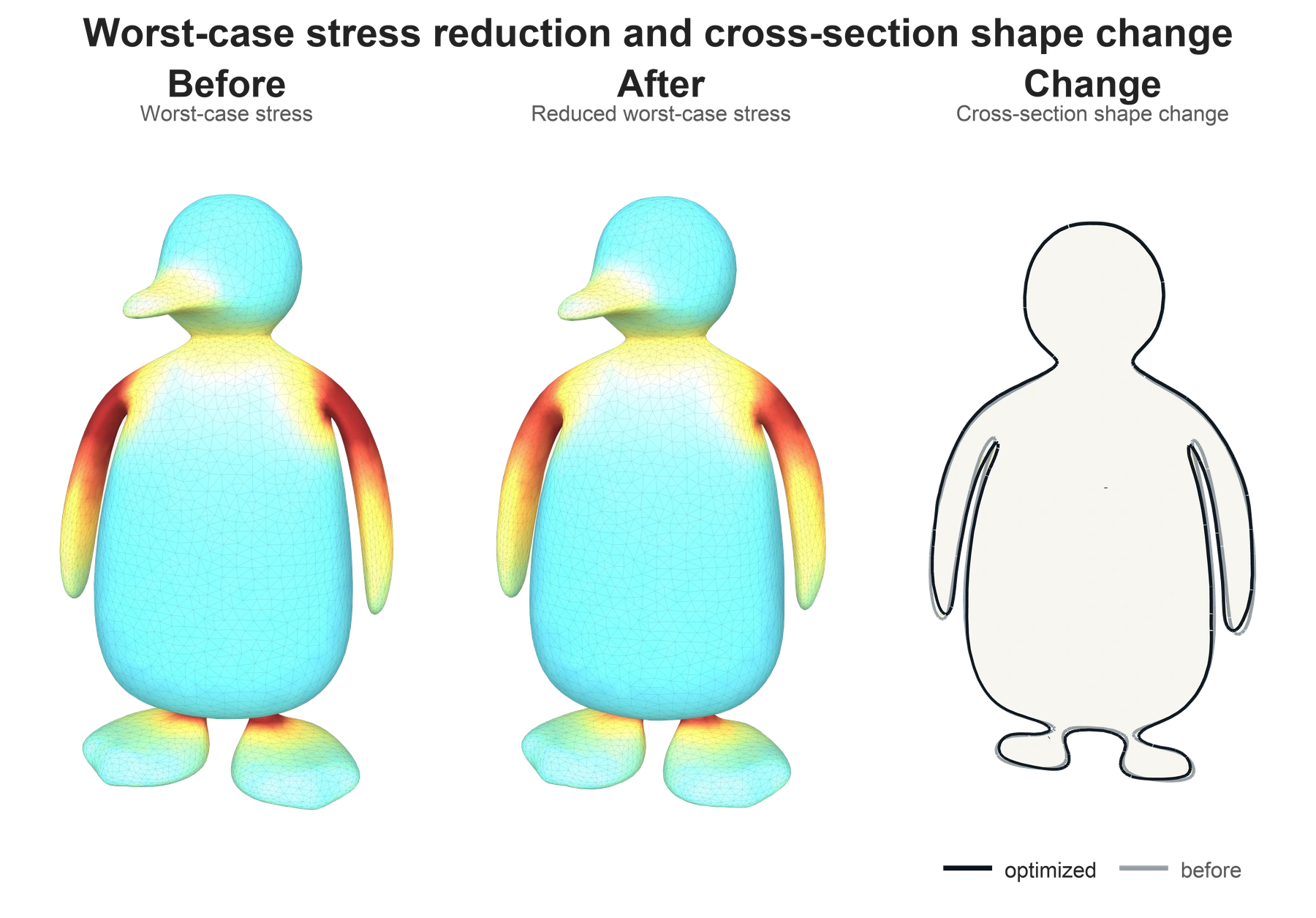
理论推导与形状优化结果:将表面载荷下的 von Mises 最坏情况分析转化为可计算的谱问题,并研究临界载荷如何驱动受约束的几何优化。Theoretical derivation and shape optimization results: formulating surface-load von Mises WCSA as a tractable spectral problem, and studying how its critical loads drive constrained geometric optimization.
01 / 形状优化Shape optimization
改变局部形状,缓解应力集中。Small shape changes. Lower stress concentrations.
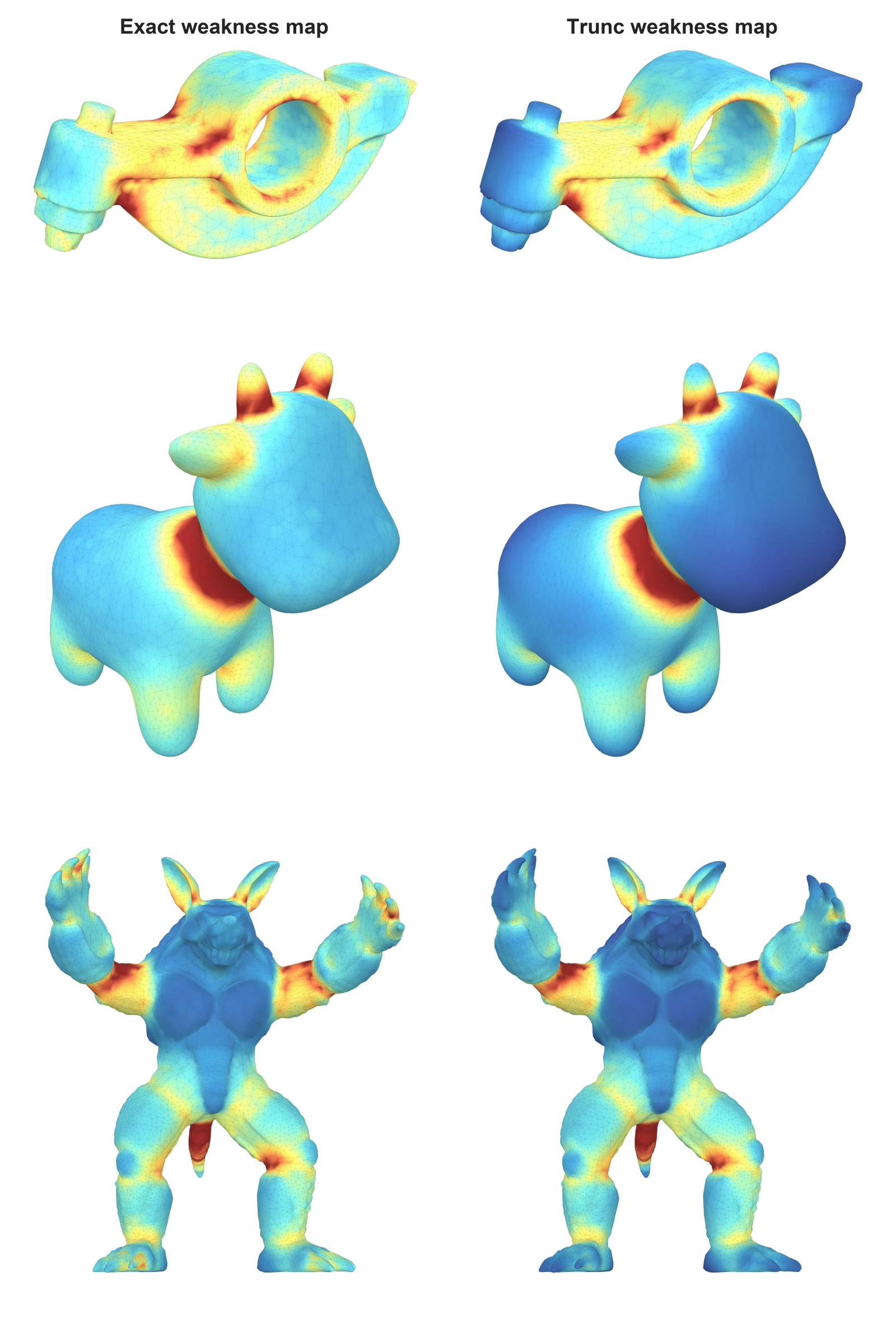
WCSA 不仅告诉我们哪里薄弱,还给出导致薄弱区域高应力的表面载荷。选取空间位置和载荷模式各异的临界载荷后,用平滑的径向基函数调整形状,并约束体积变化与位移幅度。WCSA returns both a weak-region map and the surface loads that expose those weaknesses. A diverse set of critical loads guides a smooth radial-basis deformation, constrained by volume change and displacement bounds.
以下为论文草稿中的选定设置:固定载荷、30 次优化迭代。数字为报告的应力下降比例,并非所有设置中的最大值。Selected configurations reported in the manuscript: fixed loads, 30 optimization iterations. These are reported stress reductions, not maxima over all settings.
应力下降stress reduction
1 个临界载荷1 critical load应力下降stress reduction
3 个临界载荷3 critical loads应力下降stress reduction
5 个临界载荷5 critical loads探索实验Explore the experiment
需要多少个临界载荷?How many critical loads are enough?
所选临界载荷数量Number of selected critical loads
一个载荷已获得大部分改善;增加载荷的收益较小。One critical load captures most of the improvement; additional loads offer only a small gain.
查看精确数据View exact values
| 载荷数Loads | 1 | 2 | 3 | 4 | 5 | 6 | 7 | 8 | 9 | 10 | 11 | 12 |
|---|---|---|---|---|---|---|---|---|---|---|---|---|
| 应力下降Reduction | 28.10% | 28.47% | 28.20% | 28.51% | 28.51% | 28.54% | 28.61% | 28.61% | 28.57% | 28.58% | 28.47% | 28.46% |
所选临界载荷数量Number of selected critical loads
三个载荷兼顾应力下降与计算成本。8–12 个载荷的实验出现单元翻转,属于无效几何,不能作为有效优化结果。Three loads balance stress reduction and cost. Runs with 8–12 loads produced inverted elements and are invalid geometries, not valid optimization results.
查看精确数据View exact values
| 载荷数Loads | 1 | 2 | 3 | 4 | 5 | 6 | 7 | 8 | 9 | 10 | 11 | 12 |
|---|---|---|---|---|---|---|---|---|---|---|---|---|
| 应力下降Reduction | 19.47% | 23.25% | 26.61% | 26.16% | 26.70% | 24.06% | 23.77% | 无效Invalid | 无效Invalid | 无效Invalid | 无效Invalid | 无效Invalid |
所选临界载荷数量Number of selected critical loads
分布更广的薄弱区域受益于多个载荷:五个载荷的结果明显优于一个载荷。Distributed weak regions benefit from more load cases: five loads substantially outperform a single load.
查看精确数据View exact values
| 载荷数Loads | 1 | 2 | 3 | 4 | 5 | 6 | 7 | 8 | 9 | 10 | 11 | 12 |
|---|---|---|---|---|---|---|---|---|---|---|---|---|
| 应力下降Reduction | 7.82% | 8.37% | 8.20% | 7.23% | 19.91% | 19.39% | 19.52% | 19.56% | 19.53% | 19.51% | 19.55% | 19.56% |
02 / 理论推导Theoretical formulation
把未知载荷,转化为一个小型谱问题。From unknown loads to a small spectral problem.
给定形状与支撑条件,我们寻找固定表面质量范数预算内、使某个应力采样点的 von Mises 应力最大的载荷。核心观察是:在最后取 von Mises 范数之前,载荷到局部应力的映射是线性的。Given a shape and its supports, we seek the surface load that maximizes von Mises stress at a stress sample, under a fixed surface-mass norm budget. The key observation: the load-to-stress map is linear before the final von Mises norm.
- 01
定义载荷空间Define the load space
用表面质量矩阵衡量载荷密度,统一不同表面离散下的载荷预算。Measure surface-load density using the surface mass matrix, giving a consistent load budget over the discretized boundary.
fᵀ Ms f ≤ C² - 02
构建表面响应模态Build a surface response basis
对表面 Schur 补刚度求解广义特征问题,保留前 k 个非零模态,构成紧凑的应力响应矩阵。Solve a generalized eigenproblem for the surface Schur-complement stiffness. Retain k nonzero modes to build a compact stress response matrix.
K̃s φj = μj Ms φj - 03
求最坏应力,恢复临界载荷Find the stress, recover the load
最大奇异值给出截断空间内的最坏应力;对应的奇异向量恢复引发该应力的表面载荷。The largest singular value gives the worst stress within the truncated space; its singular vector recovers the critical surface load.
Φk = C σmax(Rk)
展开:响应矩阵与截断误差A closer look: the response matrix and truncation error
在固定应力采样点,令 Pᵥₘ = LLᵀ 为 von Mises 矩阵分解,G 为位移到应力的映射,Φⱼ 为体积位移模态。第 j 列响应为:At a fixed stress sample, let Pᵥₘ = LLᵀ factor the von Mises matrix, G map displacement to stress, and Φⱼ denote the volumetric displacement mode. The j-th response column is:
因此只需对 RₖRₖᵀ 求最大特征值,其维数由 von Mises 因子空间决定,与表面自由度数无关。截断应力是所保留子空间中的最优值;若完整的被省略响应能量已知,还可得到逐点误差界:The largest eigenvalue of RₖRₖᵀ solves the problem in a space whose dimension is independent of the surface degrees of freedom. Truncated stress is optimal within the retained subspace. If the complete omitted response energy is known, it also gives a pointwise error bound:
这是有限元离散问题上的逐点关系。仅观察有限个模态的衰减,并不等于已获得完整尾项或连续体最大应力的认证。This is a pointwise relation for the finite-element discretization. Observed decay over a finite set of modes alone does not certify the complete tail or the continuum maximum stress.
03 / 更多结果More results
保留整体形状,调整关键区域。Preserve the form. Refine the vulnerable regions.
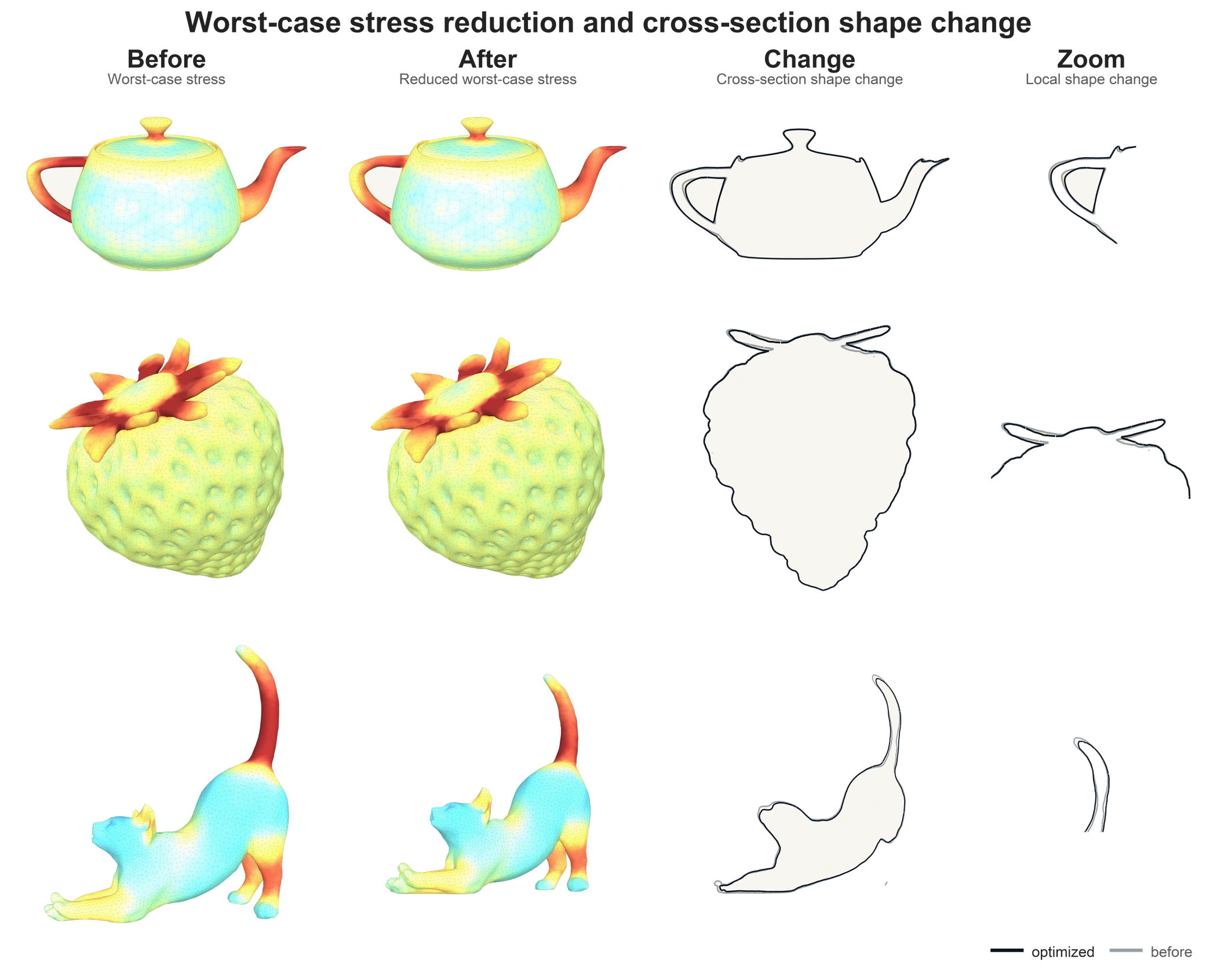
茶壶、草莓与猫模型的结果展示了局部几何调整。截面叠加与局部放大图呈现优化实际改变的位置;外轮廓的变化与应力场一起评估。The teapot, strawberry, and cat examples show localized geometric changes. Overlaid cross-sections and close-ups reveal where the optimization acts, allowing shape changes to be assessed alongside stress fields.
关于这个项目About this project
从力学推导,走向可用的设计工具。Connecting mechanics to practical design tools.
这项研究连接计算机图形学、有限元分析、谱方法与受约束优化。我的工作重点是理论推导和形状优化结果。This research connects computer graphics, finite-element analysis, spectral methods, and constrained optimization. My focus is the theoretical derivation and shape optimization results.
交流这个项目Get in touch about the project